
How to Choose the Best PPF for Durability and Value
A practical guide to choosing paint protection film: material, thickness, top coat, self-healing and warranty, with a Drive7 X Pro, XPEL and 3M comparison.
Choosing the best paint protection film isn't about price or brand name alone. It comes down to film quality, how well it suits the way you use your car, the warranty, and professional installation.
This guide covers the specs worth comparing, and whether a thicker film really means better protection.
The short answer
The best PPF isn't necessarily the most expensive or the thickest. It's the film that balances TPU quality, the right thickness, a durable top coat, resistance to yellowing and scratches, and a solid warranty and installation.
| Factor | Why it matters |
|---|---|
| Film material | High-quality TPU is preferred for its flexibility and durability |
| Total thickness | Measured across all layers, not the protective layer alone |
| TPU layer thickness | This layer takes most of the impact and abrasion |
| Top coat quality | Affects gloss and resistance to stains and surface scratches |
| Flexibility and elongation | Lets the film stretch and follow the car's curves |
| Yellowing and UV resistance | Keeps the film clear under sun exposure |
| Self-healing | Heat helps fine surface scratches disappear |
| Warranty | Shows how long you're covered and which defects are included |
| Installation quality | Affects the finish, edge hold and film lifespan |
| Value for money | Weighs specs, coverage and warranty against the price |
The point of paint protection film is simple: keep your paint in good condition for as long as possible, whatever the driving conditions.
What is PPF and what is it made of?
PPF stands for Paint Protection Film. It's a clear or matte film applied over the paint to form a physical barrier against scratches, scuffs, stone chips and road debris.
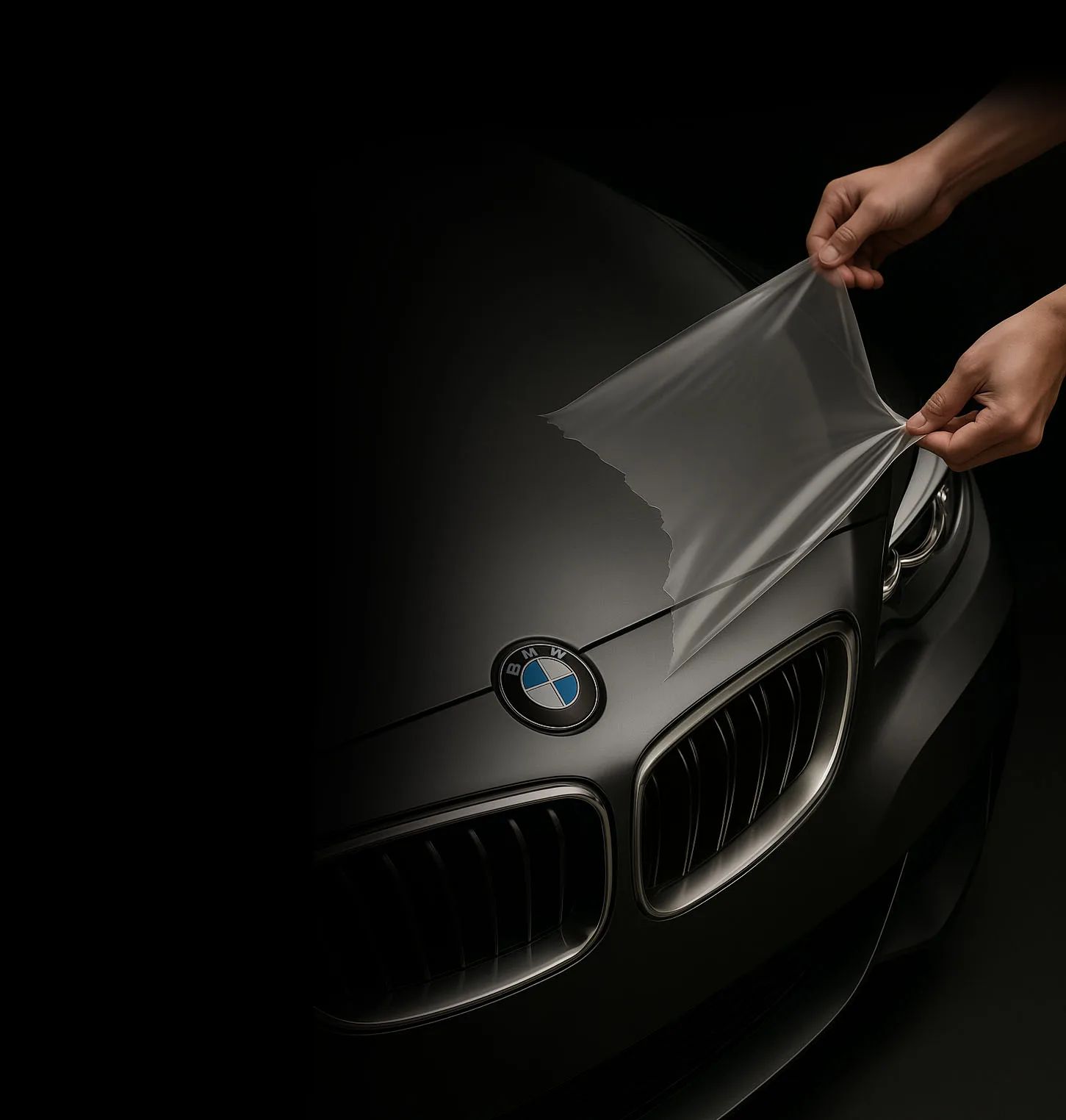
Most protection films are built from several layers, each with its own job:
Drive7 X Pro film layers

Top coat13 µm
Resists stains and fine scratches and keeps the gloss
TPU base layer153 µm
Absorbs part of the impact and gives the film flexibility and strength
Adhesive25 µm
Bonds the film to the paint while keeping it clear
Release liner— removed · not counted
Protects the adhesive before installation and is removed during the job
What stays on the car: 191 µm1
Which PPF is best for cars in Saudi Arabia?
The best protection film is the one that matches your car's value, how you drive it, and how much it's exposed to stones and scratches.
No single film is best for every car. The right choice depends on:
- Your car and how you use it.
- How many kilometers you drive.
- City driving versus highways.
- The level of protection you want.
- Your budget.
- How long you plan to keep the car.
Is a thicker film always better?
A higher PPF thickness doesn't automatically mean a better film. Thickness can affect flexibility, how easily the film shapes around panels, and how well the edges hold. The advertised figure may also cover every layer, not just the TPU.
Don't mix up mil and millimeters:
- 1 mil equals 0.001 inch, or about 25.4 microns.
- An 8 mil film is about 203 microns.
- 8 mil does not mean 8 millimeters.
How thick is the film, really?
203.2µm
0.2032mm
8 mil is about 39 times thinner than 8 millimeters.
Thickness of the three films compared
The common range: 7.5 mil (190.5) · 8 mil (203.2)
Figures as published by each maker: film with adhesive, without liner.
What's the best PPF thickness?
For everyday use, a total thickness between 7.5 and 8 mil is common across many professional protection films124, and it's within the range Drive7 uses. Cars that face harsher driving conditions may benefit from a thicker film on the front areas most exposed to stones.
What does self-healing mean?
Self-healing is the top coat's ability to make fine surface scratches disappear when exposed to heat, such as sunlight or warm water, following the product's instructions. It won't fix cuts, punctures or scratches that go through the TPU layer.
Best PPF in Saudi Arabia: Drive7 vs XPEL vs 3M
When comparing protection films, compare specific products, not just brand names. One company can sell several films that differ in thickness, layers, warranty and performance.
The table below compares published datasheet figures for:
- Drive7 X Pro
- XPEL ULTIMATE PLUS
- 3M PPF Series 100 Gloss
| Spec | Drive7 X Pro | XPEL ULTIMATE PLUS | 3M Series 100 Gloss |
|---|---|---|---|
| Base material | TPU1 | Polyurethane2 | Polyurethane4 |
| Nominal thickness | About 191 µm1 | 193 µm ±10% without liner2 | 190 µm (7.5 mil) film with adhesive4 |
| Top coat thickness | 13 µm1 | 12 µm2 | Not stated in source |
| TPU / polyurethane layer | 153 µm1 | 152 µm2 | Not stated in source |
| Gloss | 90+ GU1 | Over 90 GU2 | "High gloss", no figure4 |
| Self-healing | Yes1 | Yes2 | Yes4 |
| Elongation at break | Over 340%1 | Over 300%2 | 350%4 |
| UV resistance | Over 98%1 | Covered in weathering tests2 | No figure in source |
| Warranty | 10 years1 | 10 years3 | 7 years in the product bulletin4, 10 years on the US product page5 |
TPU is thermoplastic polyurethane, so all three films belong to the same family. Figures are as published in each product's source, with its date.
What sets Drive7 X Pro PPF apart?
Drive7 X Pro uses a multi-layer build that combines a flexible TPU layer with a top coat that helps resist stains and surface scratches while keeping the gloss and clarity. It also self-heals fine scratches, resists UV, and carries a warranty of up to 10 years under the approved terms.
It has a total thickness of about 191 microns, including a 153-micron TPU layer and a 13-micron top coat, with gloss of 90+ GU and elongation above 340%. These specs place it among the high-performance PPF options available in Saudi Arabia.
Full-body PPF or front-end only?
The choice between full-body and front-end protection depends on how you use the car, which areas are most exposed to stones and scratches, and your budget. Here's how they compare:
| Factor | Full body | Front end |
|---|---|---|
| Coverage | Most exterior body panels | The front areas most exposed to scratches |
| Cost | Higher | Lower |
| Best for | New and luxury cars | Highway drivers and mid-range budgets |
| Advantage | Uniform protection and look | Best value for money |
| Trade-off | Needs a bigger budget and more time | The rest of the car stays unprotected |
How to choose the best PPF installer in Saudi Arabia
Even the best PPF can fail with a poor installation. Choose a shop that cares about precise cutting, a clean workspace, careful edge and curve work, and a clear warranty.
At Drive7, we apply these standards at every stage, from preparing the car and precise cutting to finishing edges and curves and inspecting the film after installation. Here's what we pay attention to:
1. Computer cutting
We use digital patterns matched to your car's model and year. This protects the paint from knife marks and keeps cuts precise around sensors and openings.
2. Edges and corners
We finish edges and corners carefully to prevent wrinkles, bubbles, adhesive lines and lifting edges. Installation takes place in a clean environment to keep dust and contaminants from getting under the film.
3. Handling curves
Bumpers, mirrors and curved panels need evenly distributed tension. Over-stretching the film can thin it and cause edges to lift or lines and distortion to appear, so we account for the film's flexibility and the design of each panel. See our current PPF offers
4. Warranty and after-sales service
We explain the film details, covered panels, warranty period, included defects and warranty terms. We also offer a post-installation check to make sure the film has settled and to fix anything that shows up at the edges.
How to tell genuine PPF from low-grade film
The difference may not show on day one, but it becomes clear over time in clarity, edge hold, and resistance to scratches, heat and yellowing. Compare the film's specs, installation and warranty, not just the price.
Here, "genuine" means a documented, high-quality film, and "low-grade" means a low-quality film or one with unknown specs. Both are terms customers commonly use.
| Feature | Genuine film | Low-grade film |
|---|---|---|
| Self-healing | Helps fine surface scratches disappear with heat | Limited or undocumented |
| Surface feel | Smooth, with a top coat that's easy to care for | Rough and unpolished |
| Abrasion resistance | Holds up better to everyday scratches and scuffs | Marks quickly |
| Dirt resistance | Relatively dirt-repellent and easier to clean | Attracts more dirt |
| Edges | Hidden and precisely secured | Exposed edges that collect dust and lift |
| Durability | More flexible and stronger | Cuts or tears more easily |
| Adhesion | Holds firmly when installed correctly | May peel or separate quickly |
| Clarity | Clearer, with a sharper paint reflection | Can look hazy or show orange-peel texture |
| Layer build | Advanced layers including TPU and a high-performance top coat | Limited-performance layers |
| Yellowing resistance | Designed to resist yellowing and stay clear | More prone to yellowing |
| Heat resistance | Handles heat better | More likely to degrade or crack in heat |
| Warranty | Written warranty; Drive7 offers up to 10 years depending on the film | Unclear or undocumented warranty |
PPF checklist before you book
Before choosing a film or paying anything, check the following:
- What is the exact brand and film name?
- What is the base material, total thickness and TPU layer thickness?
- Does the film have a top coat and self-healing?
- How long is the warranty, who provides it, and what does it cover?
- Which panels are included in the package?
- Does the price include VAT and paint preparation?
- Does the shop use digital patterns for your car's model? Will any parts be removed?
- How are edges, corners and curves handled?
- Can the film be replaced on a single panel if it gets damaged?
- What are the aftercare instructions?
How much does PPF cost in Saudi Arabia?
PPF installation cost depends on the film type, car size, coverage level, warranty length and installation quality. So don't compare on price alone: check the film specs, the panels included and the warranty period.
Final prices vary by car category, size and required coverage. Offers depend on availability and duration, and you can pay in installments with Tabby and Tamara.
Packages
Choose your package
PPF FAQs
Does PPF prevent all scratches?
PPF reduces the impact of many surface scratches, scuffs, stone chips and road debris, but it doesn't make the car immune to damage.
Does self-healing repair the film after an accident?
No. Self-healing works on fine surface scratches when the film is heated, but it won't fix cuts, tears or deep damage. The damaged section may need replacing.
Is full-body PPF better than front-end only?
Not always. Full-body gives wider coverage, while front-end protection covers the most exposed areas at a lower price.
Can ceramic coating go over PPF?
Yes, PPF and ceramic coating can be combined when the products are compatible. Check the manufacturer's recommendations first.
Can PPF be removed without damaging the paint?
Yes, but the result depends on the paint's condition, the film's age, and how it was installed and removed, especially on repainted or weak paint.
Can one panel of PPF be replaced?
Yes. In many cases only the film on the damaged panel, such as a bumper or door, needs replacing, not the whole car.
Is PPF suitable for used cars?
Yes, if the paint is in good condition. It's best to inspect the car first for peeling, weak repairs or repainted panels that could be affected if the film is removed later.
Don't rely on price or thickness alone: compare the specs, coverage, installation quality and value for money.